

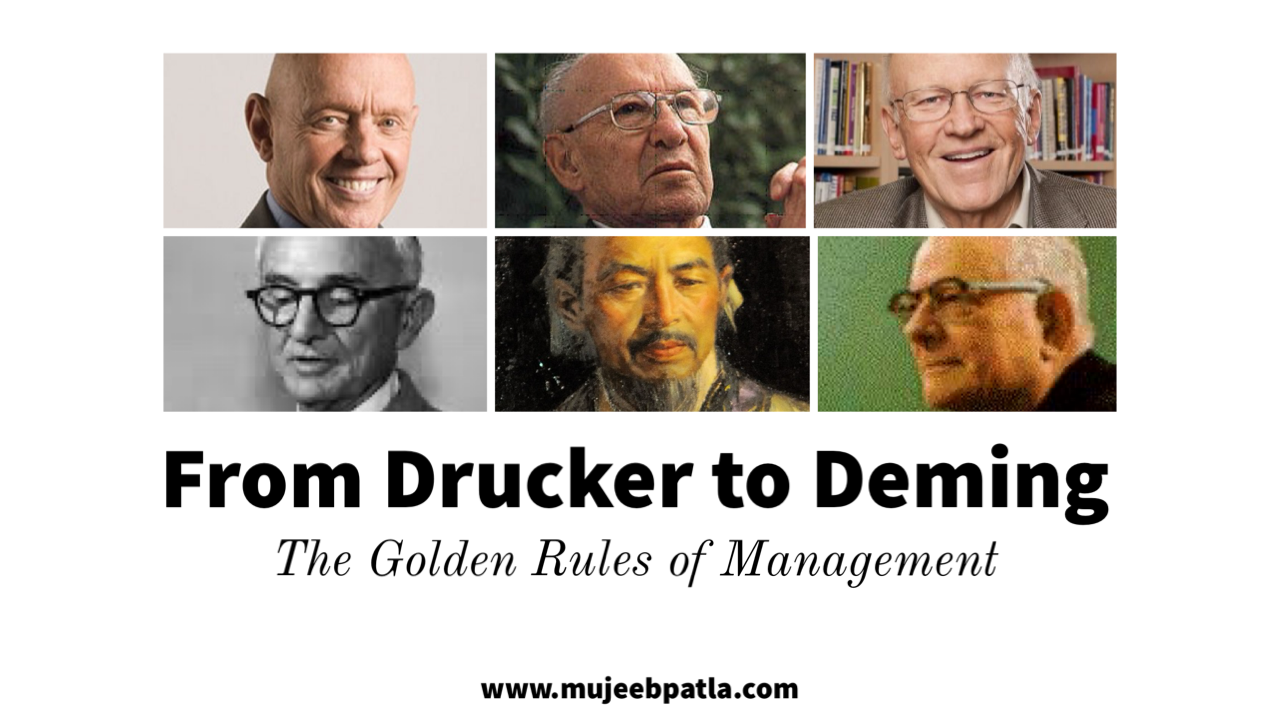
Management is a multifaceted field that has been shaped and refined by countless brilliant minds throughout history. To navigate the challenges and complexities of managing teams, projects, and organizations effectively, it is essential to understand and apply the golden rules of management. In this article, we will delve into these rules, drawing inspiration from renowned books and thought leaders in the field of management.
- Peter Drucker’s Focus on Results:
“Management is doing things right; leadership is doing the right things.” – Peter Drucker
Peter Drucker, often considered the father of modern management, emphasized the importance of results in his seminal work, “The Practice of Management.” His wisdom highlights the essential distinction between management and leadership. Management is about efficiently accomplishing tasks, while leadership is about setting the direction and making the right strategic decisions.
Drucker’s golden rule reminds us that as managers, our primary focus should be on achieving the desired outcomes. To do this, we need to ensure that we’re not just busy but that we’re busy doing the right things that align with our organizational goals.
- Stephen R. Covey’s Habit-Centric Approach:
“The key is not to prioritize what’s on your schedule but to schedule your priorities.” – Stephen R. Covey
Stephen R. Covey, in his influential book “The 7 Habits of Highly Effective People,” stressed the importance of prioritizing your most important tasks. Covey’s golden rule advises managers to proactively plan and schedule their tasks based on their significance rather than reacting to the urgencies of the moment. This approach ensures that what matters most gets the attention it deserves.
- Sun Tzu’s Strategic Thinking:
“All warfare is based on deception. Hence, when we are able to attack, we must seem unable; when using our forces, we must appear inactive; when we are near, we must make the enemy believe we are far away.” – Sun Tzu, “The Art of War”
While Sun Tzu’s “The Art of War” is primarily a treatise on military strategy, it holds valuable insights for management. The art of deception and strategic thinking is crucial in both contexts. This golden rule highlights the importance of staying several steps ahead, always anticipating your competitors’ moves, and keeping your intentions concealed until the opportune moment.
- Dale Carnegie’s People Skills:
“Talk to someone about themselves, and they’ll listen for hours.” – Dale Carnegie, “How to Win Friends and Influence People”
Dale Carnegie’s classic, “How to Win Friends and Influence People,” is a cornerstone of people skills and interpersonal effectiveness. Carnegie’s golden rule emphasizes the power of listening and showing genuine interest in others. As a manager, building strong relationships with your team members, peers, and superiors is essential for effective leadership. By focusing on others and understanding their needs and perspectives, you can foster trust and collaboration.
- W. Edwards Deming’s Continuous Improvement:
“Learning is not compulsory… neither is survival.” – W. Edwards Deming
W. Edwards Deming, known for his contributions to quality management, emphasized the importance of continuous improvement in his book “Out of the Crisis.” Deming’s golden rule underscores the idea that learning and adapting are not optional but essential for an organization’s survival and success.
Effective management involves creating an environment where employees are encouraged to learn and improve continuously. Deming’s philosophy reminds us that organizations must adapt, innovate, and evolve to stay competitive.
- Ken Blanchard’s Servant Leadership:
“The best way to predict your future is to create it.” – Ken Blanchard, “The One Minute Manager”
In “The One Minute Manager,” Ken Blanchard introduced the concept of servant leadership, emphasizing the importance of leaders serving their team members. His golden rule encourages managers to take a proactive role in shaping their future and the future of their teams. By providing guidance, support, and mentorship, managers can empower their employees to create a better future for themselves and the organization.
The golden rules of management are drawn from the wisdom of eminent thinkers like Peter Drucker, Stephen R. Covey, Sun Tzu, Dale Carnegie, W. Edwards Deming, and Ken Blanchard. These rules encompass a wide range of principles, from focusing on results and prioritizing tasks to strategic thinking, people skills, continuous improvement, and servant leadership.
By internalizing and applying these principles, managers can lead their teams more effectively, navigate complex challenges, and contribute to the success and growth of their organizations. The golden rules of management serve as a timeless guide for all those who seek to excel in the art and science of management.

 Mujeeb Patla™