
by Mujeeb Patla
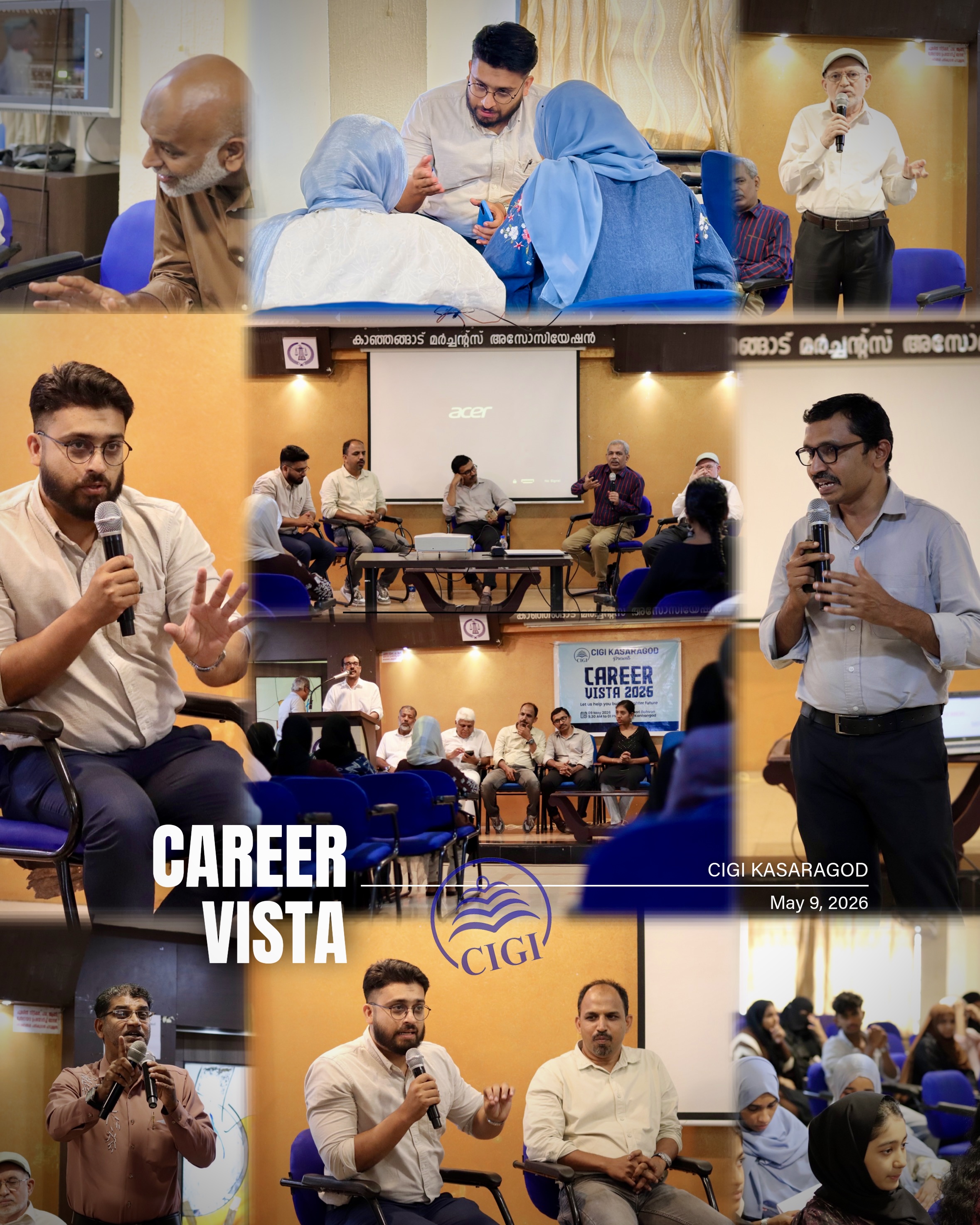
At Career Vista 2026, organized by the CIGI Kasaragod Chapter, the most important discussion did not come from the keynote stage or the expert panel.
It came from a schoolgirl.
During the interactive panel discussion, a 10th standard student stood up and asked a question directly to a panel of five career consulting experts:
“Teaching and nursing are the two fields which will not be affected by AI. Can you explain any more such career fields where AI cannot replace human workers?”
For a few seconds, the auditorium fell silent.
Because her question reflected a growing concern shared by students, parents, professionals, and even organizations worldwide:
What happens to human careers in an AI-driven economy?
The Anxiety of an Entire Generation
Today’s students are entering a world fundamentally different from the one their parents prepared for.
Previous generations competed primarily with other humans.
The emerging generation must learn to compete — and collaborate — with intelligent machines.
Artificial Intelligence is no longer a futuristic concept. It is rapidly integrating into industries such as education, healthcare, finance, design, logistics, customer service, manufacturing, and even creative work.
During the discussion, I referenced the work being done by Squirrel AI, founded by Derek Haoyang Li, Founder and CEO of Squirrel AI Learning, whose Large Adaptive Model (LAM)-based educational systems are reshaping how students learn and how education may evolve in the AI era.
These technologies are designed to personalize learning pathways, analyze student performance patterns, and optimize educational outcomes at a scale that traditional systems cannot easily match.
For many students in the audience, this realization was unsettling.
If AI can teach, analyze, design, write, diagnose, automate, and predict — then where does human value remain?
The Wrong Question
The most common career question students ask today is:
“Which jobs are safe from AI?”
But this may be the wrong framework entirely.
History shows that technological revolutions rarely eliminate human relevance altogether. Instead, they redefine the nature of human contribution.
The Industrial Revolution automated physical labor.
The Digital Revolution automated information processing.
The AI Revolution is beginning to automate pattern recognition and routine cognitive work.
Yet every major technological shift has also created entirely new categories of opportunity.
The future may not belong to people who avoid AI.
It will belong to those who understand how to integrate AI into their workflows effectively.
From AI to HI: The New Competitive Advantage
During the session, I emphasized a concept that may become increasingly important over the next decade:
Human Intelligence (HI) integrated with Artificial Intelligence (AI).
AI can process data.
But humans create meaning.
AI can generate answers.
But humans ask transformative questions.
AI can optimize efficiency.
But humans build trust, empathy, ethics, leadership, and emotional connection.
This is why careers centered around human interaction, judgment, creativity, relationship-building, negotiation, mentorship, caregiving, and ethical decision-making will continue to remain highly valuable — even in highly automated environments.
The future workforce will require a hybrid capability model:
- Technical adaptability
- AI collaboration skills
- Communication ability
- Emotional intelligence
- Creativity
- Critical thinking
- Ethical reasoning
- Continuous learning mindset
Students who develop these competencies early will not merely survive technological disruption; they will lead within it.
Education Must Evolve Faster Than Ever
One important observation from Career Vista 2026 was the increasing awareness among school students themselves.
Students today are no longer passively choosing careers based only on social status or traditional assumptions. They are actively questioning employability, technological disruption, global mobility, financial sustainability, and long-term relevance.
This signals an important shift.
Career guidance can no longer be limited to listing courses and colleges. It must now include:
- AI literacy
- Industry transformation awareness
- Human skill development
- Adaptability training
- Digital collaboration capability
- Lifelong learning orientation
Educational institutions, parents, and career mentors must recognize that preparing students for the future now involves preparing them for coexistence with intelligent systems.
A Defining Moment
Career Vista 2026 featured three major sessions:
- A keynote discussion on careers in 2026 and future-ready decision-making
- An expert panel interaction where students directly engaged with career consultants
- One-to-one counseling sessions for students and parents
Yet the defining moment of the event was not a presentation slide or a prepared speech.
It was a young student asking a difficult question with honesty and courage.
Because beneath that question lies the defining challenge of our era:
In a world increasingly shaped by machines, what makes human beings irreplaceable?
The answer may ultimately determine not just future careers — but the future of education itself.

 Mujeeb Patla™