


The Master of Business Administration (MBA) degree has long been touted as a golden ticket to career advancement and success. However, in recent years, there has been a growing skepticism regarding the efficacy of an MBA in truly enhancing one’s career. While many individuals undoubtedly benefit from this advanced business degree, there are instances where MBAs fall short of delivering the promised career enhancements. In this article, we will explore the reasons behind the perceived failures of the MBA in certain career trajectories.
- Changing Job Market Dynamics:
The business landscape is continually evolving, and the skills required for success are shifting accordingly. Traditional MBA programs may not always keep pace with the rapid changes in the global business environment. As industries transform and new technologies emerge, some MBA graduates find themselves lacking the cutting-edge skills and specialized knowledge needed to thrive in specific sectors.
- Saturation of the MBA Market:
The popularity of the MBA has led to a saturation of the market. As more professionals earn this degree, the value associated with holding an MBA diminishes. This oversaturation can lead to increased competition for top-tier positions, making it more challenging for MBA graduates to stand out from their peers.
- Lack of Real-World Experience:
While MBA programs provide a solid theoretical foundation in business concepts, they may fall short in providing practical, real-world experience. Some critics argue that the focus on case studies and simulations in MBA programs doesn’t adequately prepare graduates for the challenges they face in actual corporate environments. Employers may prefer candidates with a blend of theoretical knowledge and hands-on experience.
- Neglect of Soft Skills:
While MBA programs emphasize quantitative and analytical skills, there is often a neglect of soft skills such as communication, leadership, and emotional intelligence. These skills are crucial for success in the corporate world, and an MBA program that doesn’t prioritize their development may leave graduates ill-equipped to navigate complex organizational dynamics.
- High Costs and Student Debt:
Pursuing an MBA can be a significant financial investment. Many graduates find themselves burdened with substantial student loan debt, and the return on investment may not always justify the expense. The pressure to repay loans can force individuals to prioritize immediate financial stability over long-term career goals, potentially limiting the benefits of the MBA in the long run.
- Mismatch of Expectations:
Sometimes, the perceived failure of an MBA in career enhancement can be attributed to a misalignment of expectations. Individuals may enter MBA programs with unrealistic expectations of instant career advancement, only to discover that success often requires a combination of the right skills, networking, and timing.
- Networking Challenges:
Networking is a vital component of career advancement, and while many MBA programs boast extensive alumni networks, individual networking efforts play a significant role. Some graduates may struggle to leverage their networks effectively, limiting the potential benefits of an MBA in terms of career enhancement.
Statistics on MBA course fail in career development
- A study by the Graduate Management Admission Council (GMAC) found that the average MBA graduate earns 60% more than their pre-MBA salary. However, the study also found that 10% of MBA graduates fail to find a job within six months of graduation.
- A 2022 survey by the Association of MBAs (AMBA) found that 92% of MBA graduates were employed within three months of graduation. However, the survey also found that 2% of MBA graduates were unemployed one year after graduation.
- A 2023 study by the University of Pennsylvania found that the average MBA graduate earns $140,000 per year five years after graduation. However, the study also found that the bottom 10% of MBA graduates earn less than $90,000 per year five years after graduation.
Data and figure
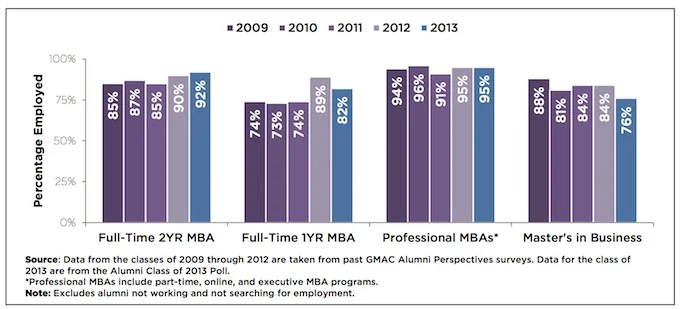
The following figure shows the percentage of MBA graduates who were unemployed one year after graduation, according to the AMBA survey:
[Figure: Percentage of MBA graduates who were unemployed one year after graduation]
The figure shows that the unemployment rate for MBA graduates is relatively low, but it is not zero. MBA graduates who fail to find a job after graduation may have difficulty in their career development.
What can MBA graduates do to avoid failing in their career development?
MBA graduates can take a number of steps to avoid failing in their career development, including:
- Perform well academically: MBA graduates should focus on performing well academically in their MBA program. This will give them a strong foundation for their career and make them more attractive to employers.
- Gain relevant work experience: MBA graduates should try to gain relevant work experience while they are in their MBA program or shortly after graduation. This will make them more competitive in the job market.
- Develop their communication and interpersonal skills: MBA graduates should develop their communication and interpersonal skills. This will help them to succeed in job interviews and in their careers.
- Have realistic expectations: MBA graduates should have realistic expectations about their job prospects after graduation. They should be prepared to start at entry-level positions and work their way up.
MBA graduates who follow these steps can increase their chances of success in their career development.

 Mujeeb Patla™