


In their raw format, we refer to brands as symbols, icons, or even a sign of an offering. This offering can be a product, a service, or even a gesture. The signs and symbols the brand signifies possess specific implications besides the conventional and obvious meaning (Bastos and Levy, 2012). Brands also serve the role of a differentiator (Shariq, 2018). Throughout history, the brand has served many functions, among which one is as a transaction facilitator and considered the producer’s property (Veloutsou, 2008). Though branding existed along with humans in history, corporate branding emerged in the 1970s. Brands are often managerially driven and less academically inspired in their corporate format (Bastos and Levy, 2012; Fetscherin and Usunier, 2012; Room, 1998).
Branding emerged as a central theme in marketing in the twentieth century. It would be 1922 when the word “brand” entered the marketing world as a trade or proprietary name (Stern, 2006). Before becoming a widespread business practice, brands were rarely linked with selling retail goods because many products distributed for consumers’ consumption were in the form of staples in bulk handled by one general store in town without labeling any of the specific sources of those goods. However, at the end of the nineteenth century and the beginning of the twentieth century, sources’ identities started becoming increasingly associated with utility, resulting in product packaging, labeling, and promotion of the product’s u. Psychological theories, understandings, and methods began to find their application in marketing thinking and research during the 1930s. Parallelly though, managers of competing brands sought to understand the increasing segmentation of the mass market, which resulted in the growth of marketing research (Bastos and Levy, 2012).
The late 1940s and the 1950s witnessed a surge in buying (also referred to as – the Consumer Revolution), which resulted from productive resources crafted for war efforts (the second world war greatly influenced this), accumulation of capital, and the pent-up consumer demand, which led to intense competition and the proliferation of brands. In this scenario, less-known and new brands challenged the top names, and many established big brands had to vacate space for the new ones. Mcdonald’s, Burger King, Pepsi-Cola, and Starbucks were some of the newly emerged brands at the time (Bastos and Levy, 2012; Rajaram and Shelly, 2012).
The marketing ideology of 1945 – 1989 is particularly interesting to the commercial world because of the emergence of “brands” as a symbol and differentiation mark by producers and consumers. Another exciting shift in the marketing ideology during the period was its focus change from the seller’s perspective to appreciation of the customer’s motivations. Moreover, perceptions entailed the second significant change in marketing ideology of this era. The rising concept of the brand helped marketers define their buyer segments and focus on managers’ concern with competing successfully by gaining and retaining brand enthusiasts. During this phase, vocabulary broadened to reflect those changes – along with “brand name” and “brand image,” “brand switching,” and “brand loyalty” too found their space, which altered the worldview of the marketing professionals.
(Levy and Luedicke, 2013)
Recent trends in marketing have led marketing ideology to focus more on branding. And the brand concept turned out to help focus the manifold and multichannel marketing efforts in complex market environments (Levy and Luedicke, 2013). The idea of the brand has transformed from a trademark and a logo into a complex network of social discourses animated by multiple brand interest groups materially expressing their views of the brand’s implied meaning (Mühlbacher et al., 2006). When competing with their counterparts, a party, let it be people, things, institutions, or even nations, turn their uniqueness, identification, and professional offerings into brands. With a logo and a competitive positioning, such brand differentiation gets cultivated more systematically (Füller et al., 2008).
At the end of the 2000s, marketing ideology appears to have retained its basic worldview and general ideas about its socio-cultural contribution. During this time, the brand concept as a complex socio-cultural phenomenon entered a vital position in Western marketing ideology. Moreover, it started to unfold its power in Eastern markets (Cayla and Eckhardt, 2008; Levy and Luedicke, 2013).
In 55 years, a relatively shorter period, the functions and thoughts related to branding evolved from ownership and reputation to brand image, symbolic values, fantasy, and relationship partners. It was in the twentieth century that a brand, an entity that until then had mostly been acted on by its immediate creators, became more democratic and absorbed inputs from an extensive array of actors. This relatively recent development of the concept naturally widened its applicability in business and research (Bastos and Levy, 2012).
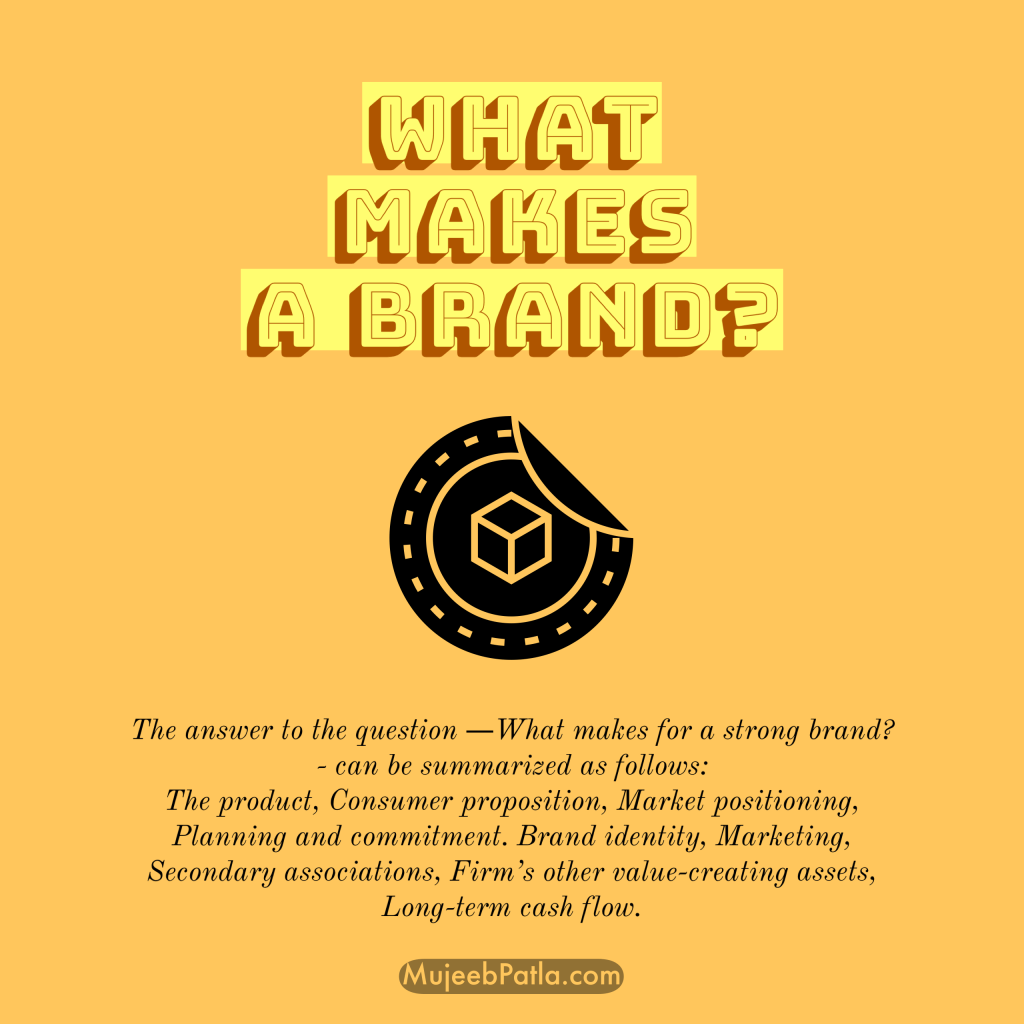
The answer to the question ―What makes for a strong brand? – can be summarised as follows:
- The product
- Consumer proposition
- Market positioning
- Planning and commitment
- Brand identity
- Marketing
- Secondary associations
- Firm’s other value-creating assets
- Long-term cash flow
(Doyle, 2001; Keller, 2005; Kotler et al., 2008; Shariq, 2018)
REFERENCE
Aldousari, A.A., Robertson, A., Ab Yajid, M.S., Ahmed, Z.U., 2017. Impact of employer branding on organization’s performance: Vol 22, No 3. J. Transnatl. Manag. 22, 153–170.
Balmer, J.M.T., Gray, E.R., 2003. Corporate brands: what are they? What of them? Eur. J. Mark. 37, 972–997. https://doi.org/10.1108/03090560310477627
Bastos, W., Levy, S.J., 2012. A history of the concept of branding: practice and theory. J. Hist. Res. Mark. 4, 347–368. https://doi.org/10.1108/17557501211252934
Biswas, M.K., Suar, D., 2016. Antecedents and Consequences of Employer Branding. J. Bus. Ethics 136, 57–72. https://doi.org/10.1007/s10551-014-2502-3
Burmann, C., Piehler, R., 2013. Employer Branding vs. Internal Branding – Ein Vorschlag zur Integration im Rahmen der identitätsbasierten Markenführung. Unternehm. 67, 223–245. https://doi.org/10.5771/0042-059x-2013-3-223
Cayla, J., Eckhardt, G.M., 2008. Asian Brands and the Shaping of a Transnational Imagined Community. J. Consum. Res. 216–230.
Chernatony, L. de, 1999. Brand Management Through Narrowing the Gap Between Brand Identity and Brand Reputation: J. Mark. Manag. 15, 157–179. https://doi.org/10.1362/026725799784870432
Doyle, P., 2001. Building value-based branding strategies. J. Strateg. Mark. 9, 255–268.
Fetscherin, M., Usunier, J., 2012. Corporate branding: an interdisciplinary literature review. Eur. J. Mark. 46, 733–753. https://doi.org/10.1108/03090561211212494
Foster, C., Punjaisri, K., Cheng, R., 2010. Exploring the relationship between corporate, internal and employer branding. J. Prod. Brand Manag. 19, 401–409. https://doi.org/10.1108/10610421011085712
Füller, J., Luedicke, M.K., Jawecki, G., 2008. How brands enchant: Insights from observing community driven brand creation. Adv. Consum. Res. 359–366.
Harris, F., de Chernatony, L., 2001. Corporate branding and corporate brand performance. Eur. J. Mark. 35, 441–456. https://doi.org/10.1108/03090560110382101
Hulberg, J., 2006. Integrating corporate branding and sociological paradigms: A literature study. J. Brand Manag. 14, 60–73. https://doi.org/10.1057/palgrave.bm.2550054
Keller, K.L., 2005. Strategic Brand Management Process, in: Esch, F.-R. (Ed.), Moderne Markenführung: Grundlagen — Innovative Ansätze — Praktische Umsetzungen. Gabler Verlag, Wiesbaden, pp. 83–101. https://doi.org/10.1007/978-3-8349-4541-9_3
Kotler, P., Keller, K.L., Koshy, A., Jha, M., 2008. Marketing Management: A South Asian Perspective. Pearson Education.
Levy, S.J., Luedicke, M.K., 2013. From Marketing Ideology to Branding Ideology. J. Macromarketing 33, 58–66. https://doi.org/10.1177/0276146712459656
Mokina, S., 2014. Place and Role of Employer Brand in the Structure of Corporate Brand. Econ. Sociol. 7, 136–148. https://doi.org/10.14254/2071-789X.2014/7-2/11
Mühlbacher, H., Hemetsberger, A., Thelen, E., Vallaster, C., Massimo, R., Füller, J., Pirker, C., Schorn, R., Kittinger, C., 2006. Brands as Complex Social Phenomena. Proc. Thought Lead. Int. Conf. Brand Manag. Birm. UK.
Ngo, L.V., Nguyen, N.P., Huynh, K.T., Gregory, G., Cuong, P.H., 2019. Converting internal brand knowledge into employee performance. J. Prod. Brand Manag. 29, 273–287. https://doi.org/10.1108/JPBM-10-2018-2068
Potgieter, A., Doubell, M., 2020. The influence of employer branding and employees’ personal branding on corporate branding and corporate reputation. Afr. J. Bus. Econ. Res. 15, 107–133. https://doi.org/10.31920/1750-4562/2020/v15n2a6
Rajaram, S., Shelly, C.S., 2012. History of branding. Int. J. Soc. Sci. Interdiscip. Res. Vol.1 No. 3, 100-104.
Room, A., 1998. History of Branding, in: Hart, S., Murphy, J. (Eds.), Brands: The New Wealth Creators. Palgrave Macmillan UK, London, pp. 13–23. https://doi.org/10.1007/978-1-349-26070-6_2
Shariq, M., 2018. Brand Equity Dimensions.
Stern, B.B., 2006. What Does Brand Mean? Historical-Analysis Method and Construct Definition [WWW Document]. URL https://journals.sagepub.com/doi/abs/10.1177/0092070305284991 (accessed 1.23.23).
Tamberg, V., Badin, A., 2009. PR strategy. Corporate image formula | High branding. Brand Work.
Veloutsou, C., 2008. Branding: A constantly developing concept. J. Brand Manag. 15, 299–300. https://doi.org/10.1057/bm.2008.2
Xia, H., Yang, L., 2010. The Employer Branding and Employee Performance, in: 2010 3rd International Conference on Information Management, Innovation Management and Industrial Engineering. Presented at the 2010 3rd International Conference on Information Management, Innovation Management and Industrial Engineering, pp. 536–538. https://doi.org/10.1109/ICIII.2010.609

 Mujeeb Patla™